Can hyperbaric oxygen therapy influence the brain processes involved in addiction?
Researchers are investigating whether hyperbaric oxygen therapy (HBOT) may influence opioid withdrawal symptoms, brain inflammation and the chemical signalling systems involved in substance dependence.
Several scientific studies have produced intriguing findings.
Small human trials have investigated HBOT alongside medically supervised treatment for opioid use disorder. Animal studies have also explored changes in dopamine signalling and specialised immune cells within the brain.
But how convincing is the evidence?
Can increased oxygen availability influence the brain’s response to drug withdrawal? And could hyperbaric chambers eventually play a role in addiction research?
This guide examines the published evidence, including human clinical trials, animal experiments and the biological mechanisms researchers are investigating.
Important: HBOT is not an established treatment for addiction or substance use disorders. The research discussed here is preliminary and does not demonstrate that hyperbaric chambers cure addiction, prevent relapse or replace evidence-based treatment.
1. What Is a Hyperbaric Chamber?
A hyperbaric chamber is an enclosed pressure system designed to operate above normal atmospheric pressure.
In clinical hyperbaric oxygen therapy, a person breathes medical oxygen while exposed to increased ambient pressure.
Under these conditions, the amount of oxygen dissolved in blood plasma can increase substantially.
This can influence oxygen delivery to tissues and trigger physiological responses that researchers continue to investigate.
How Does Hyperbaric Oxygen Therapy Work?
At normal atmospheric pressure, most oxygen in the blood is transported by haemoglobin.
Under increased pressure, breathing oxygen at a high concentration increases the amount dissolved directly in plasma.
This is one reason HBOT has established medical applications for certain conditions.
Researchers are also examining its effects on:
- Cellular responses to oxygen
- Inflammatory signalling
- Oxidative stress
- Blood vessel function
- Neural tissue responses
- Cellular repair mechanisms
However, the biological effects depend on pressure, oxygen concentration, exposure duration and treatment schedule.
Not all hyperbaric chambers provide the same oxygen exposure.
A low-pressure chamber using air or oxygen-enriched gas cannot automatically be considered equivalent to a clinical HBOT protocol involving 100% oxygen at 2.0 ATA.
Hyperbaric Chambers in the UK
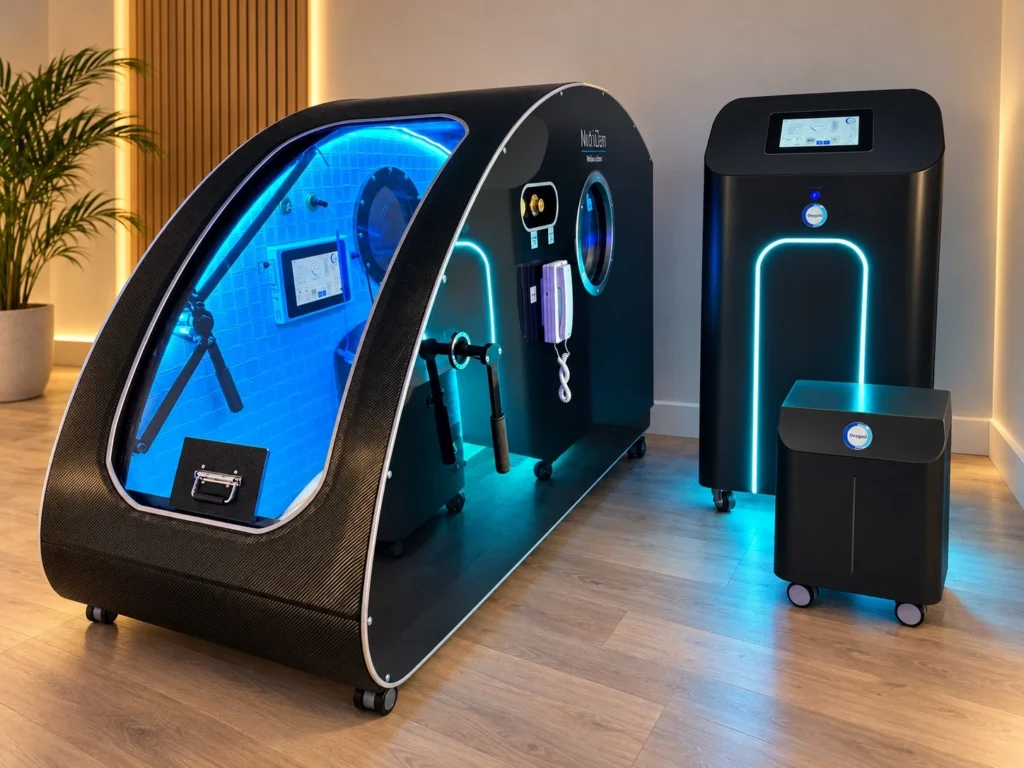
Oxygens supplies hyperbaric chamber equipment, including soft-shell systems and the UK-manufactured Winslet hard-shell range.
For information about available equipment, visit:
The equipment available from Oxygens should not be assumed to reproduce the research protocols described below or to be suitable for treating addiction.
2. What Happens in the Brain During Addiction?
Addiction involves changes in several interacting brain systems.
These include reward processing, motivation, learning, memory, stress responses and behavioural control.
Repeated exposure to addictive substances can alter the way these systems respond to rewards and environmental cues.
The Role of Dopamine
Dopamine is a neurotransmitter involved in motivation, learning and reward-related processes.
Many addictive substances influence dopamine signalling within brain circuits that include the nucleus accumbens.
However, addiction cannot be explained simply as having too much or too little dopamine.
It involves complex adaptations across multiple neurotransmitter systems and neural networks.
The Brain’s Reward System
The mesolimbic dopamine pathway is frequently discussed in addiction research.
It includes connections between the ventral tegmental area and nucleus accumbens.
These networks help the brain learn which experiences and cues predict important outcomes.
Repeated substance exposure can alter reward learning and motivation.
Stress and Withdrawal
When someone becomes physically dependent on a substance, stopping or reducing it can produce withdrawal symptoms.
These vary depending on the substance.
Opioid withdrawal, for example, may involve:
- Muscle aches
- Gastrointestinal symptoms
- Restlessness
- Anxiety
- Sleep disruption
- Sweating
- Increased sensitivity to discomfort
- Strong urges to use opioids
Withdrawal symptoms can make recovery more difficult.
Researchers have therefore investigated whether additional interventions might help people remain engaged with established treatment programmes.
3. Hyperbaric Oxygen Therapy and Opioid Withdrawal: Human Research
One of the most relevant areas of research involves opioid use disorder.
Two small randomised studies published in 2022 investigated HBOT as an additional intervention for people receiving methadone treatment.
Study 1: HBOT for Opioid Withdrawal, Pain and Cravings
Published: 2022
Journal: Pain Management Nursing
Researchers: Wilson and colleagues
This pilot randomised controlled trial involved eight adults prescribed methadone for opioid use disorder.
Participants were assigned to either:
- HBOT at 2.0 atmospheres absolute, breathing 100% oxygen
- A sham condition involving room air at minimal pressure
The intervention consisted of two consecutive daily sessions lasting approximately 90 minutes.
Researchers measured outcomes including withdrawal symptoms, cravings, pain, sleep and mood.
What Did the Study Find?
The researchers reported more favourable average changes in several outcomes among participants receiving HBOT.
The largest positive effects were observed for pain intensity and drug craving.
However, clinically observed withdrawal symptoms did not show the same pattern of improvement.
The trial was extremely small, involving only eight participants.
Its results are therefore preliminary and cannot establish clinical effectiveness.
Read the original study:
Hyperbaric Oxygen Therapy for Pain, Opioid Withdrawal, and Related Symptoms — PubMed
What Does This Mean?
The study provides a reason to conduct larger clinical trials.
It does not establish that HBOT treats opioid addiction or reliably reduces cravings.
The distinction matters because improvements in symptoms over a short period do not necessarily translate into sustained recovery.
4. Can HBOT Help People Reduce Methadone?
A second randomised study investigated whether HBOT could support people undergoing medically supervised methadone dose reduction.
Published: 2022
Journal: Journal of Addictions Nursing
The study randomised 31 adults receiving methadone treatment.
Participants were assigned to an HBOT group or an attention-control group.
The HBOT protocol involved five consecutive daily sessions at 2.0 ATA while breathing 100% oxygen.
Each session lasted approximately 90 minutes.
Study Findings
The researchers reported that, at three months, the HBOT group maintained an average methadone dose reduction of 4.3 mg.
The control group maintained an average reduction of 0.25 mg.
The researchers also observed greater average reductions in reported withdrawal symptoms after the first HBOT session.
These findings are interesting, but several limitations are important.
The study was small, treatment attendance was incomplete, and the comparison group did not receive a matched hyperbaric sham procedure.
Consequently, the results do not establish that HBOT caused the differences observed.
Why This Research Matters
Difficulty tolerating withdrawal symptoms can interfere with medically supervised opioid treatment.
The researchers investigated whether HBOT might eventually serve as an additional supportive intervention.
However, larger trials are needed to determine whether it provides meaningful benefits beyond established treatment.
Read the original study:
Hyperbaric Oxygen to Assist Adults With Opioid Use Disorder in Reducing Methadone Dose — PubMed
5. The 2025 Study: HBOT, Opioid Withdrawal and Brain Inflammation
A particularly interesting study was published in Scientific Reports in July 2025.
Title: Hyperbaric oxygen treatment attenuates naloxone-precipitated opioid withdrawal behaviors and alters microglial activity in male and female mice.
Researchers investigated the effects of HBOT in mice exposed to morphine.
The study examined both physical withdrawal behaviours and changes in microglia, specialised immune cells found in the central nervous system.
What Are Microglia?
Microglia help maintain the brain’s internal environment.
They participate in immune surveillance, responses to injury and the regulation of inflammatory processes.
Microglia can change their shape and activity in response to different physiological conditions.
Researchers are investigating whether altered microglial activity contributes to some aspects of substance dependence and withdrawal.
What Did the Researchers Discover?
The 2025 study reported three important findings.
First: HBOT reduced certain physical signs of opioid withdrawal in both male and female mice.
Second: Researchers observed changes in microglial cell morphology within the paraventricular thalamus.
Specifically, HBOT was associated with reduced microglial soma volume, which the authors interpreted as consistent with a shift towards a less activated state.
Third: HBOT did not significantly alter the conditioned reward or aversion behaviours examined in the study.
Why Is This Important?
The findings suggest that HBOT may influence some biological processes associated with physical opioid withdrawal.
However, the study did not establish that HBOT changes the motivational processes responsible for addiction.
It also did not demonstrate that HBOT prevents relapse.
Crucially, this was an animal study, not a clinical trial involving people with addiction.
Does This Prove HBOT Reduces Brain Inflammation?
Not conclusively.
Changes in microglial morphology may be consistent with altered inflammatory activity, but they do not independently establish that HBOT reduces harmful neuroinflammation in humans with substance use disorders.
The researchers identified a possible mechanism that requires further investigation.
Read the full peer-reviewed study:
Scientific Reports — Hyperbaric Oxygen Treatment and Opioid Withdrawal (2025)
6. Hyperbaric Oxygen Therapy and Dopamine: What Does the Research Show?
Dopamine is an important neurotransmitter in addiction research.
A 2018 study investigated how HBOT affected neurotransmitter signalling in morphine-dependent rats.
Study title: Hyperbaric Oxygen Attenuates Withdrawal Symptoms by Regulating Monoaminergic Neurotransmitters and NO Signaling Pathway at Nucleus Accumbens in Morphine-Dependent Rats.
What Did the Researchers Investigate?
The researchers used a laboratory model of morphine dependence.
They then examined withdrawal-related behaviours and biochemical changes following hyperbaric oxygen exposure.
Particular attention was given to the nucleus accumbens, a brain region involved in reward-related processing.
What Did the Study Find?
Compared with the untreated morphine-dependent group, animals receiving HBOT showed:
- Reduced withdrawal symptom scores
- Less withdrawal-associated body-weight loss
- Changes in noradrenaline signalling
- Increased dopamine levels in the nucleus accumbens
- Increased expression of tyrosine hydroxylase
- Changes in nitric oxide-related signalling pathways
Tyrosine hydroxylase is an enzyme involved in the production of catecholamine neurotransmitters, including dopamine.
Does This Mean HBOT Restores Dopamine in People With Addiction?
No.
The study involved rats, not humans.
Its findings do not establish that HBOT normalises dopamine signalling in people with substance use disorders.
Nor do they demonstrate improvements in long-term addiction outcomes.
Nevertheless, the results provide a biological hypothesis that researchers may investigate in future studies.
Read the study:
Hyperbaric Oxygen, Dopamine and Morphine Withdrawal — PubMed
7. Can Hyperbaric Oxygen Therapy Help the Brain Recover?
The brain is highly dependent on a continuous supply of oxygen.
Oxygen supports cellular energy production and many processes necessary for normal neural function.
Under carefully controlled conditions, hyperbaric oxygen therapy can increase the amount of oxygen dissolved in blood plasma.
Researchers have investigated whether this altered oxygen environment may influence neurological recovery in selected circumstances.
Potential mechanisms under investigation include:
Cellular Energy Metabolism
Brain cells require energy to maintain electrical signalling